

Data center development is expanding across the region
Data centers are popping up across Virginia, and they’re starting to stir up conversations about their effects on residential real estate.
While Northern Virginia remains the center of the state’s data center industry, development is expanding into Greater Richmond and Hampton Roads. That growth is bringing new investment and tax revenue to localities, but it’s also raising concerns from homeowners and homebuyers about noise, utilities, nearby development and property values.
The impact of data centers on home values
The National Association of REALTORS® examined the issue in its 2026 Data Center Impact Report. Among real estate professionals surveyed, 25% said data centers had a positive effect on nearby home values, while 22% reported a negative effect.
When it comes to buyer demand, NAR found 26% of REALTORS® reported decreased residential demand near data centers, compared with 19% who saw increased demand.
Research from Realtor.com reached a similar conclusion. It compared home prices in ZIP codes where large data centers opened between 2019 and 2025 with similar areas that did not get one. Researchers found no statistically meaningful difference in sale or listing prices during the first two years after a data center opened.
That doesn’t mean an individual home right next door to a data center will be unaffected. Location, visibility, noise, traffic and other factors can impact one property more than another. But so far, the broader research doesn’t support the idea that a nearby data center automatically lowers home values.
Homebuyer concerns about living near data centers
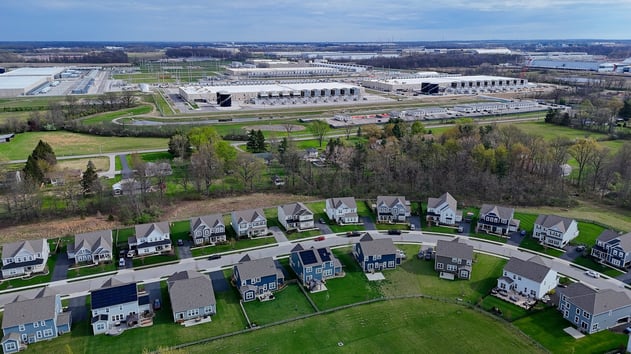 A 2026 Redfin survey found 53% of U.S. residents opposed the construction of an AI data center in their neighborhood, while 34% supported it.
REALTORS® are hearing concerns from their clients, too. According to NAR’s 2026 survey, energy costs topped the list of concerns reported
by real estate professionals, at 61%. Water use followed at 56%, while 43% cited perceived environmental contamination and 32% cited changes to the immediate landscape. Data centers require large amounts of electricity to power their servers, and some facilities use significant amounts of water for cooling. Nearby residents may also have concerns about noise from cooling equipment and backup generators, as well as the size and appearance of the facilities themselves.
Even if the effect on home values remains unclear, those concerns can still influence how buyers look at a property. Buyers may already check for nearby highways, industrial properties or planned development. Data centers could become another thing to research before making an offer.
Greater Richmond communities are responding differently to data center growth
Greater Richmond is a good example of just how differently communities are responding to data centers.
Henrico, Chesterfield and Powhatan counties have all attracted data center development, bringing the potential for significant tax revenue. In Powhatan, the county estimates a planned $3 billion data center campus could eventually generate about $10 million in additional property tax revenue each year.
But some proposed projects have faced significant opposition.
Residents in Henrico have pushed back against proposed data center expansion, including a 2026 QTS proposal near White Oak. Chesterfield residents have also spoken out about data center growth, raising concerns about electricity and water use, noise and the location of future projects. Despite the pushback, data center development is continuing.
Hanover County has seen a different outcome. Hundreds of residents attended a 2025 community meeting to oppose the proposed 400-acre Hunting Hawk Technology Center. The developer later withdrew its application. A separate 427-acre proposal on Mountain Road also faced months of opposition before the Hanover Board of Supervisors rejected it in May 2026.
Data center development expands across Greater Williamsburg and Hampton Roads
Data center development hasn’t reached the same scale in Greater Williamsburg, but local officials are already preparing for it. James City County adopted a Data Facilities Policy in 2025 and has been considering additional requirements for future projects.
 Farther down Interstate 64, Virginia Beach has become an important location for digital infrastructure because of undersea fiber-optic cables that connect the city with other parts of the world. Virginia Beach Economic Development has used that infrastructure to market the city for data center development, including available sites at Corporate Landing Business Park.
Chesapeake has also tightened its rules. In August 2026, the city changed its ordinance so data centers generally require a conditional-use permit outside the Coastal Virginia Commerce Park. Before the change, the city found that more than 27,000 homes were within 500 feet of property where a data center could potentially have been permitted under previous zoning rules.
Data centers can increase the value of land
Land with the right combination of power, fiber access and zoning can become especially valuable to data center developers. NAR found 50% of real estate professionals surveyed reported increased commercial property values near data centers, while 42% reported increased demand for nearby commercial space, particularly industrial property and land.
So, this creates an unusual situation. A homeowner may not want a data center nearby, while a landowner with property suitable for one could receive a significant offer for their property from a data center developer.
Looking ahead at data center development and local real estate
As data centers become a bigger part of life in Virginia, their presence is something to consider when buying or selling a home. Their impact can depend on where they’re built, what surrounds them and what could be developed nearby in the future.
How localities respond will play a role, too. Some projects have been withdrawn or rejected following public opposition, while others have moved forward despite pushback. Those different outcomes could help shape what data center development means for Virginia real estate in the coming years.
Have questions about how data centers could affect your real estate plans? Connect with a local Liz Moore & Associates agent who knows the market.
Stay up to date



Browse Posts




- October 2026
- September 2026
- July 2026
- June 2026
- May 2026
- April 2026
- February 2026
- January 2026
- July 2025
- May 2025
- April 2025
- March 2025
- February 2025
- January 2025
- October 2024
- September 2024
- August 2024
- July 2024
- June 2024
- April 2024
- March 2024
- February 2024
- January 2024
- December 2023
- November 2023
- October 2023
- September 2023
- August 2023
- July 2023
- June 2023
- May 2023
- April 2023
- March 2023
- February 2023
- January 2023
- December 2022
- November 2022
- October 2022
- September 2022
- August 2022
- July 2022
- June 2022
- May 2022
- April 2022
- March 2022
- February 2022
- January 2022
- December 2021
- November 2021
Browse by topics
- Buyers (14)
- Locals - 101 Reasons (0)
- Sellers (7)
- Williamsburg (1)
- New Homes (0)
- Home Sale Statistics & Trends (6)
- Community (47)
- event (0)
- Newport News (0)
- lizlocal-richmond-realestate (48)
- lizlocal-williamsburg-realestate (49)
- lizlocal-peninsula-realestate (44)
- York County (0)
- events (0)
- Richmond (0)
- lizlocal-NorthernNeck-realestate (42)
- Fords Colony (0)
- Home Page (0)
- event-Peninsula (0)
- Hampton (0)
- Neighborhood Spotlight (4)
- lizlocal (0)
- event-Williamsburg (1)
- event-Richmond (0)
- Poquoson (0)
- Seniors (8)
- lizlocal-richmond-community (21)
- lizlocal-williamsburg-community (22)
- About (27)
- lizlocal-Peninsula (0)
- careers (1)
- lizlocal-Richmond (0)
- Investors (0)
- lizlocal-Peninsula-community (18)
- lizlocal-Williamsburg (0)
- lizlocal-NorthernNeck-livelocal (13)
- relo-richmond-local (0)
- relo-williamsburg-local (0)
- relo-peninsula-local (0)
- Military (0)
- lizlocal-NorthernNeck-community (15)
- lizlocal-peninsula-livelocal (11)
- lizlocal-richmond-livelocal (12)
- timeline (0)
- MarketTalk (18)
- lizlocal-williamsburg-livelocal (12)
- Rivers Bend at Uncles Neck (0)
- Peninsula (2)
- Monticello Woods (0)
- 55+ (9)
- Downsizing (9)
- New Kent (0)
- Perkinson Homes (0)
- buyer (4)
- Oaks at Fenton Mill (0)
- WYD1 (8)
- commercial (8)
- lizlocal-NorthernNeck-food_and_drink (5)
- RVA Home Building (0)
- WYD3 (7)
- buy (7)
- lizlocal-richmond-food_and_drink (4)
- relo-richmond-news (0)
- WYD4 (6)
- WYD5 (6)
- golf (0)
- relo-peninsula-news (0)
- relo-williamsburg-news (0)
- Brickshire (0)
- Kingsmill (0)
- Quarterpath (0)
- WYD2 (4)
- Westport (0)
- land (0)
- Braemar Creek (0)
- Chesterfield (0)
- Hilton Village (0)
- Kiln Creek (0)
- New Town (0)
- Patriots Landing (0)
- Queens Lake (0)
- Village Park (0)
- lizlocal-peninsula-food_and_drink (1)
- lizlocal-williamsburg-food_and_drink (0)
- waterfront (0)
- 101 (0)
- Colonial Heritage (0)
- Coventry (0)
- Governors Land (0)
- Greensprings West (0)
- Port Warwick (0)
- Smithfield (0)
- Stonehouse (0)
- Virginia Beach (2)
- White Hall (0)
- seller (1)
- Brandermill (0)
- Brandon Woods (0)
- Data Centers (1)
- Greater Richmond (1)
- Hallsley (0)
- Hampton Park (0)
- Hampton Roads (1)
- Hanover (0)
- Home Values (1)
- Homeowners (1)
- Merrimac Shores (0)
- Midlothian (0)
- Norfolk (1)
- Real Estate Trends (1)
- Running Man (0)
- The Greenlands (0)
- The Settlement At Powhata (0)
- Villas at Oxford Run (0)
- West Point (1)
- Woodlake (0)
- kensington Woods (0)
- lizlocal-richmond-liz_local (1)
- lizlocal-southside-livelocal (1)
- press release (1)
- the point on fishers creek (0)

Liz Moore & Associates is a boutique real estate agency renowned for having the region's top agents, with extensive market knowledge and local expertise that is only achieved through relentless training coupled with Liz's extremely high standards for professionalism. When you're buying or selling a home, experience matters.